Vrises Agiou Vasileiou
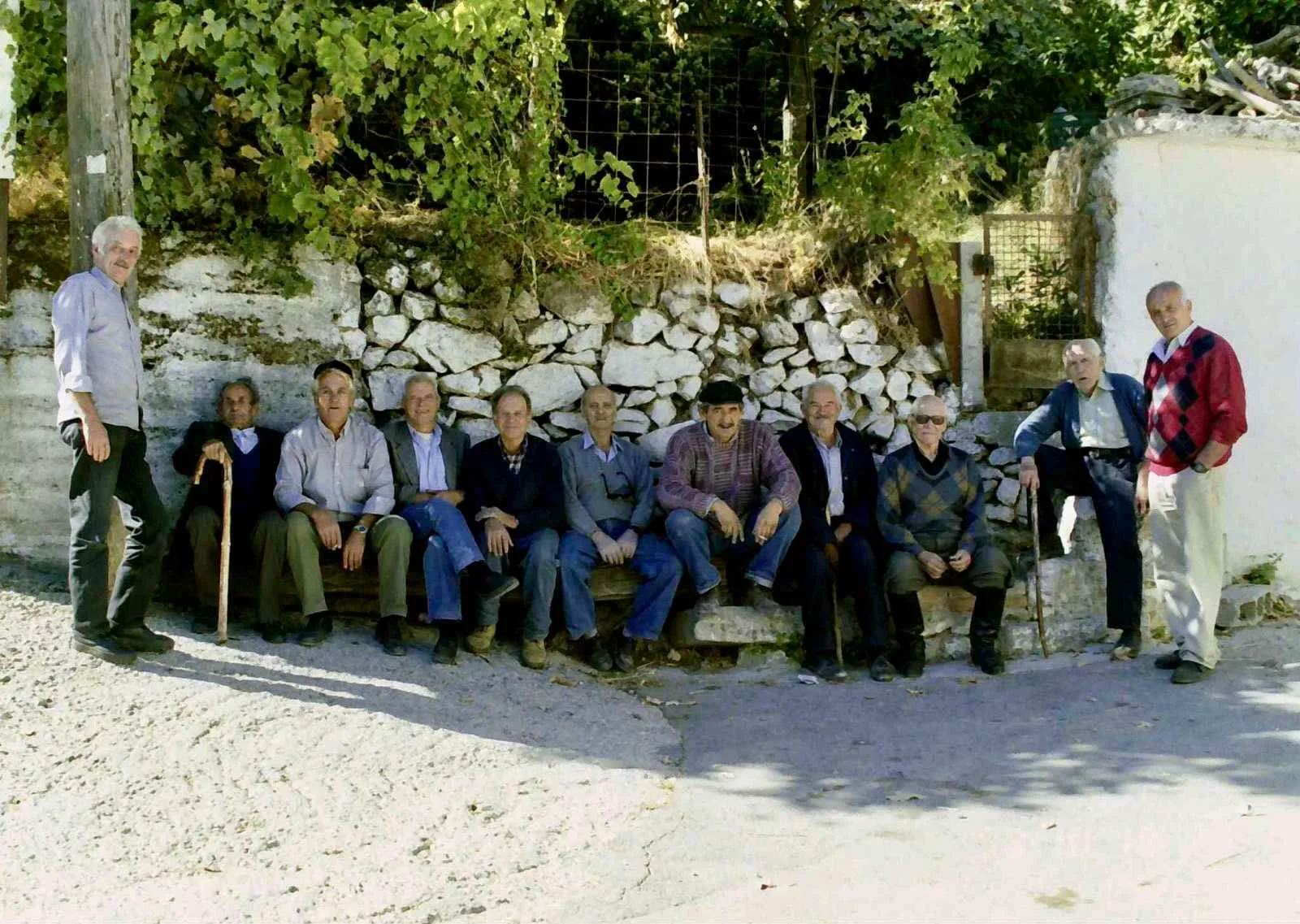
Vrises lies 36 km from Rethymno, on the right branch at the 35th km of the main road to Agia Galini. It is built on the northeastern slopes of Mount Sideroto (1,136 m), at an altitude of 550 m.
The village owes its name to its two fountains (vryses), one in the upper village and one in the lower part.
- First mention
- 1577
- Altitude
- 550m
- Residents (2011)
- 84
Name and historical course
The earliest known mention of the village dates from 1577, when Francesco Barozzi recorded it in the province of Agios Vasileios as 'Vrisses de Cumia', the Vryses of Koumia. It is mentioned again in 1583 with 121 residents, and under the same name in the Basilicata of 1630. In the Egyptian census of 1834 it appears as 'Vrysis' and in 1881 as 'Vryses', in the Municipality of Agios Pnevma, with 158 Christian residents.
In 1920 it formed its own community with 220 residents, while in 1928 it was placed under the Akoumia community with 245 residents. The village reached its largest population in 1961, with 285 residents. It had 170 residents in 1981, 143 in 1991 and about 84 in 2011.
Cretan Revolution 1866-1869
8 December 1868
The Deadly Battle at the Akoumovrysanos River
After Arkadi, it was the greatest tragedy of the Cretan Revolution.
On 8 December 1868, at the Akoumovrysanos river, one of the bloodiest battles of the Cretan Revolution was fought between the Turks and the volunteers of Dimitrios Petropoulakis together with the Cretan revolutionaries.
Petropoulakis, a colonel of the royal phalanx from Mani, had landed at Fodele in late November 1868 with the ships 'Ydra' and 'Panellinion'. He had been sent by the Voulgaris government with 800 volunteers, most of them from Laconia, armed with new weapons.
On 8 December, as they advanced towards Trachilas and Kissos, they came up against a large Turkish army led by four pashas. At Trachilas near Kentrochori, above the Akoumovrysanos river, they were surrounded in fog and heavy rain that let them see only a few metres ahead. Cretan revolutionaries and veteran volunteers led by Mitsas, Zikos and Xanthoudakis fought alongside them.
The fierce battle lasted three hours. About 200 volunteers and revolutionaries were killed or captured, and 12 more drowned in the storm's torrential waters while trying to cross the river.
The survivors gathered at the village of Kerame and from there moved west to Kallikratis in Sfakia, where the final act was played out. The battle, known today also as the battle of Trachilas-Agios Pnevmatos, marked the beginning of the end of the revolution.
Today a memorial to the fallen stands at Trachilas, where a memorial service is held on the anniversary of the battle.
Churches
Dormition of the Theotokos, the parish church of the village.
Saint George.
Saint Stephen.
Towers and caves
The towers
In the centre of the village stood two neighbouring towers, a large one and a smaller one, alike in their architecture and Venetian in style. Tradition holds that they belonged to the wealthy Byzantine noblewoman Maria and passed first to the Venetians and later to the Turks. Others believe they were built under Ottoman rule.
The tower that survives today stands in ruins. It was probably built in the early Ottoman period (late 17th to early 18th century) of rubble masonry. It is one of the few surviving examples of a narrow-fronted rectangular tower from this period and is designated a historic preserved monument.
The caves
Gaidaroles or Trypa Cave is located north of the village, in the Pachtotiko area.
Trypa of Orthos Poros is a cave at the Orthos Poros site. During Ottoman rule, and later during the German occupation, residents took refuge there.
Notable People of Vrises
- Nikolaos G. Papadakis (1874-1945)Professor of Classical Philology and rector of the University of Thessaloniki. Discovered the ancient city of Vionnos (Kionia) near Kerames.
- Emmanouil Fragkedakis (1892-1982)Doctor, surgeon, humanitarian and prolific author. Twice honored by the Academy of Athens.
- Alexandros N. PapadakisProfessor of Mineralogy at the University of Thessaloniki.
- Konstantinos PapadakisPolitician and Macedonian Struggle fighter.
- Michalis Grigorakis (1926)Teacher, headmaster of Perama, trade unionist and Rethymno politician with the Communist Party.
- Stefanos PavlakisHead of a cultural movement, founder of a Development Company and author.
- Michail GrigoriadisInventor of a new firearm in 1883; lived in Belgium.
- Eva GrigorakiSinger with notable musical collaborations.
Sources: Wikipedia · rethnea.gr (Lefteris Kryovrysanakis) · N. Fasataki 'The former province of Agios Vasileios' 2003.